One thing you notice today is that everyone is stressed about AI.
Every week or two there is a new model, a new tool, a new editor. At the same time, you hear CEOs saying that maybe we won’t need software engineers in the future, then you see big companies laying off thousands of engineers.
Naturally, we start wondering about the future and asking questions like:
- Will my job exist in the next two years ?
- Am I going to be jobless ?
- Did I choose the wrong career ?
But the real question is: Who the f benefits from this?
Who Benefits from AI Hype
AI companies like Anthropic and OpenAI are receiving massive investments from big companies like Microsoft, Meta, Google, Oracle, and many more.
When that much money is involved, AI companies can’t afford for AI to slow down as a trend. They need it to keep growing. If their investors see AI hype decline, the source of cash disappears and they’ll be in trouble, since most AI companies are not profitable.
They will do everything they can to keep AI in the spotlight—even if it means putting every software engineer in constant stress and making them addicted to AI.
How They Keep AI in the Spotlight
Whenever the hype starts to slow down, something new appears.
This system runs on fear of missing out (FOMO) and aims to keep you asking:
- Am I falling behind ?
- Do I need to learn this new thing ?
- Will I get fired for not using AI ?
AI Trends Are Not Worth Your Time
Zoom out a bit and you’ll see that 90% of these trends are not worth your time. The stress benefits them, not you.
How to reduce stress:
- Reduce consuming AI news; if it’s important, you’ll hear about it anyway.
- Every month or two, do a round of updates and try new things.
- Most AI terms and jobs are just software jobs with some AI on top. As long as you’re a software engineer, you’ll learn what you need when you need.
AI Coding Addiction
Every prompt you write is a bet. If it works, you get happy and get cheap dopamine with no effort. If it doesn’t work, no problem, you will save the wasted time by prompting again. That is the definition of poker.
Just like poker, you start little by little:
- First some code in the browser
- Then it moves to your editor (Copilot, Cursor, …)
- Then to the terminal (Codex, Claude Code…)
Each time you rely on it more, until you can’t work without it. You don’t even notice it, and you keep saying “yeah, I can do it alone”. But in reality your skills are slowly fading.

The conclusion:
AI gives short-term benefits but hurts you in the long term.
And companies does not care about you; they only care about your speed to return their investment, so they will keep pushing AI.
The Illusion of Productivity
Ever pick up your phone to do something and waste an hour on social media, but 20 minutes reading a book feels like two hours?
The same thing happens when using AI since it is addictive.
AI productivity gains exist, but they’re often overestimated. And most time saved now is spent later debugging, since you don’t develop a mental map of the code when using it.
Context Switching: Your Worst Enemy
When you start working, your brain doesn’t hit full power immediately, it needs a warm-up. It slowly gathers context, builds momentum, and eventually operates at its peak.
AI destroys that process:
Every time you stop to write a prompt and wait for a response, your brain drops the context it just spent 30 minutes building. When the AI finishes, you have to rebuild that context from scratch and that costs time and energy.
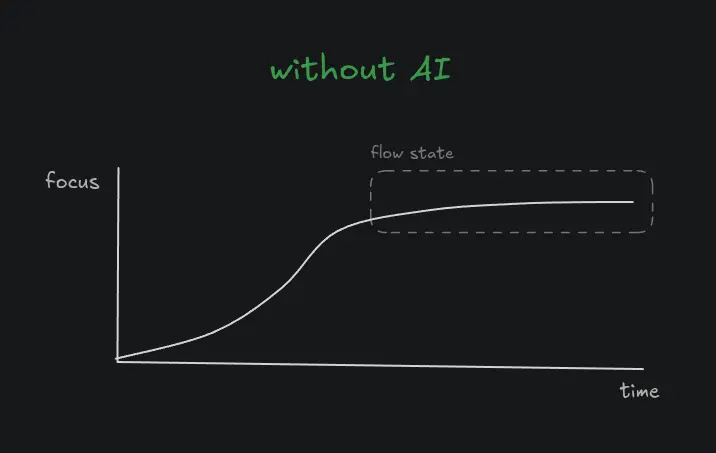
Without AI
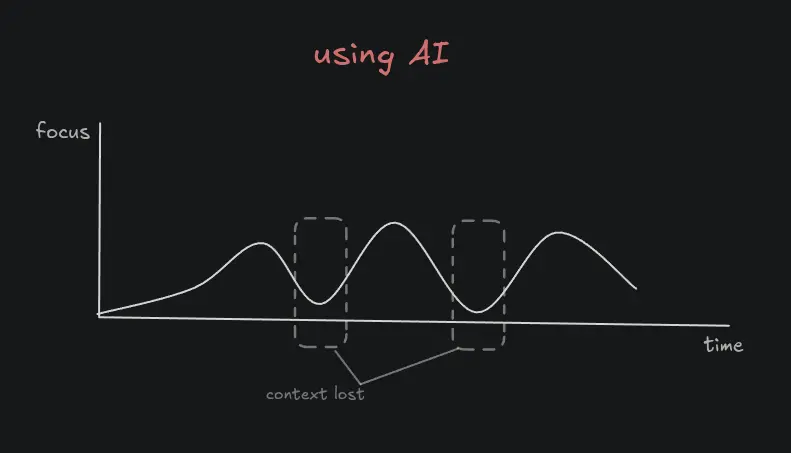
Using AI
There’s a deeper issue too. Reaching your maximum cognitive capacity requires effort (cognitive load), When AI handles that effort instead of you, your brain never fully engages and over time, that can make you dumber.
Note: Your IQ isn’t fixed, it’s dynamic. You’ve probably noticed this during exams: by the end of the session, you can suddenly solve problems that stopped you at the start. That’s why hard questions are usually placed last. Your brain gets sharper the more you use it.
Solution
Last year I made the decision to only use AI in the browser, never in the editor or the terminal. It’s the best decision I ever made.
Now I’m faster, I know every part of my codebase, and I can still code without it when needed. When there’s something AI can implement, I give it the relevant code as context along with detailed instructions since I already understand my own code.
LLMs are also incredible for code review. Whenever I implement a new feature or some business logic, I ask the AI if there are any issues or edge cases I missed.
| Good Uses ✅ | Never Let AI Handle ❌ |
|---|---|
| Boilerplate code | Architecture (DB, codebase…) |
| Repetitive tasks (form validation, pagination…) | Solving problems you haven’t solved yourself |
| Code review & CI/CD (human in the loop) | Business logic |
| Fake data generation | Final code review |
| Documentation (with human oversight) | Debugging |
| Mentoring (verify answers) | Major refactors |
| UI prototypes | UX decisions |
| Small refactors | IDE code completion |
Conclusion
AI is a useful tool, but only if you control how you use it.
The hype is fake, the FOMO is on purpose, and the addiction is by design. None of that is for your benefit.
What actually helps you is staying sharp: knowing your own code, solving your own problems, and only using AI when it makes sense .
Your skills are what matter long term. Don’t trade them for shortcuts.
Use AI. Just don’t let it use you.